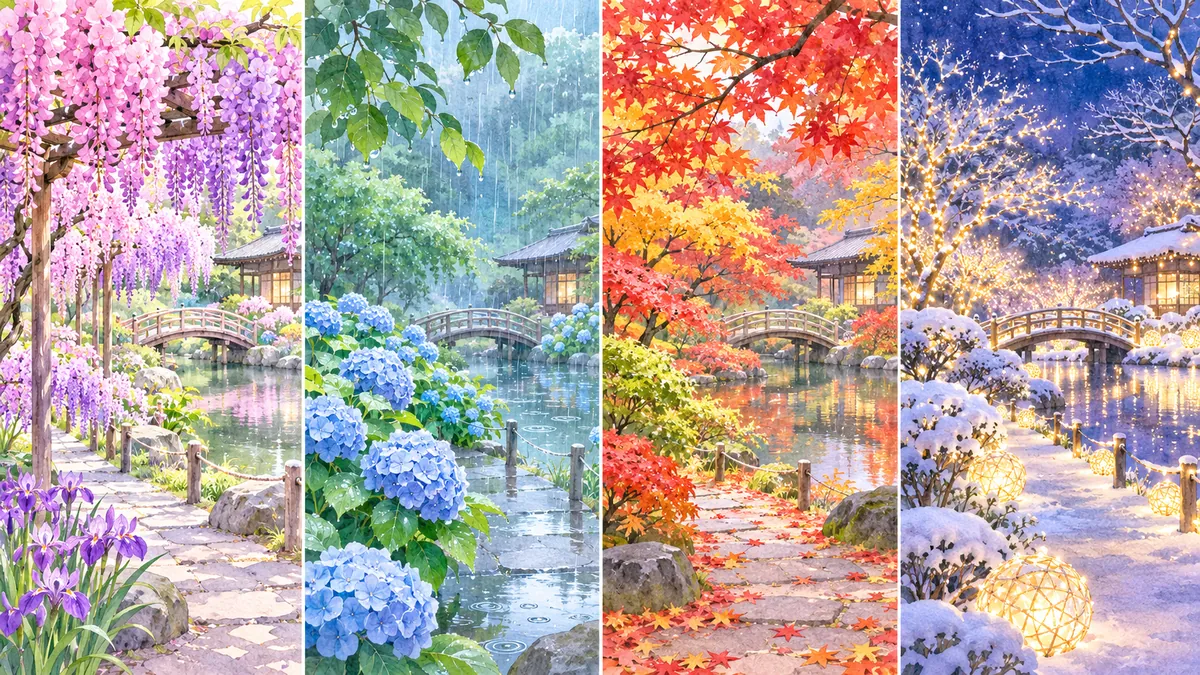
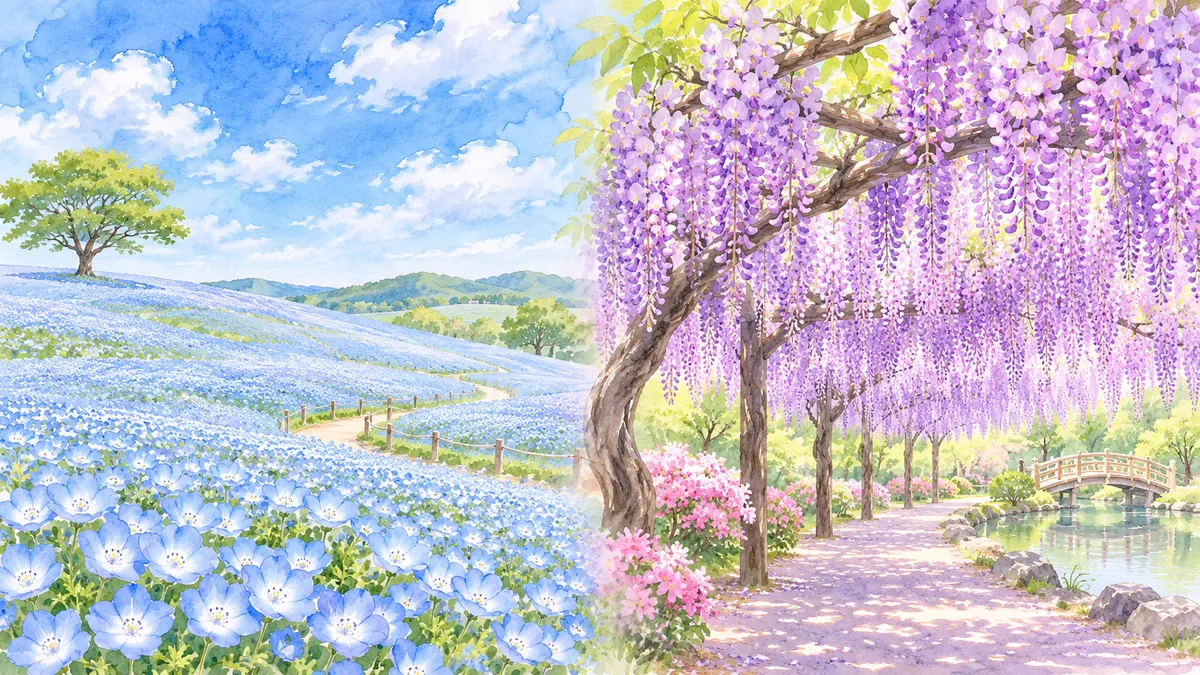
The wisteria at Ashikaga Flower Park opens in sequence from about mid-April to mid-May, and the great wisteria, the park’s 160-year-old canopy, usually peaks from late April to early May. The 2026 festival ran from 11 April to 20 May; the 2027 dates have not been announced yet, so plan on mid-April to around 20 May. For the great wisteria at its fullest, aim for the last week of April or the first days of May, and go on a weekday if you can, because peak bloom lands on Golden Week. In spring the shared Blue Flower Hill Nemophila & Ashikaga Flower Park coach pairs the wisteria with Hitachi Seaside Park, with both admissions included.
Nemophila and wisteria spring coach
The Order the Wisteria Blooms at Ashikaga Flower Park
The colours open one after another, so the display lasts a little over a month, against the four or five days of a cherry blossom peak. Light pink comes first, then purple and the great wisteria with the dark purple Yae Kokuryu, then white, then the yellow tunnel.
| Colour | Usual peak | What you see |
|---|---|---|
| Light pink | Mid to late April | The first trellises in flower, often with the azaleas |
| Purple, the great wisteria and Yae Kokuryu | Late April to early May | The great wisteria canopy and the double, dark purple Yae Kokuryu |
| White | Early May | The 80-metre white wisteria tunnel |
| Yellow (laburnum) | Early to mid May | The yellow tunnel, last to flower |
These windows come from past seasons. In 2026 the flowers opened on 8 April, a week earlier than usual, so a warm spring can move every row forward. Peak bloom is not guaranteed on any date, and no tour can make the flowers open.
The Great Wisteria and the White Tunnel
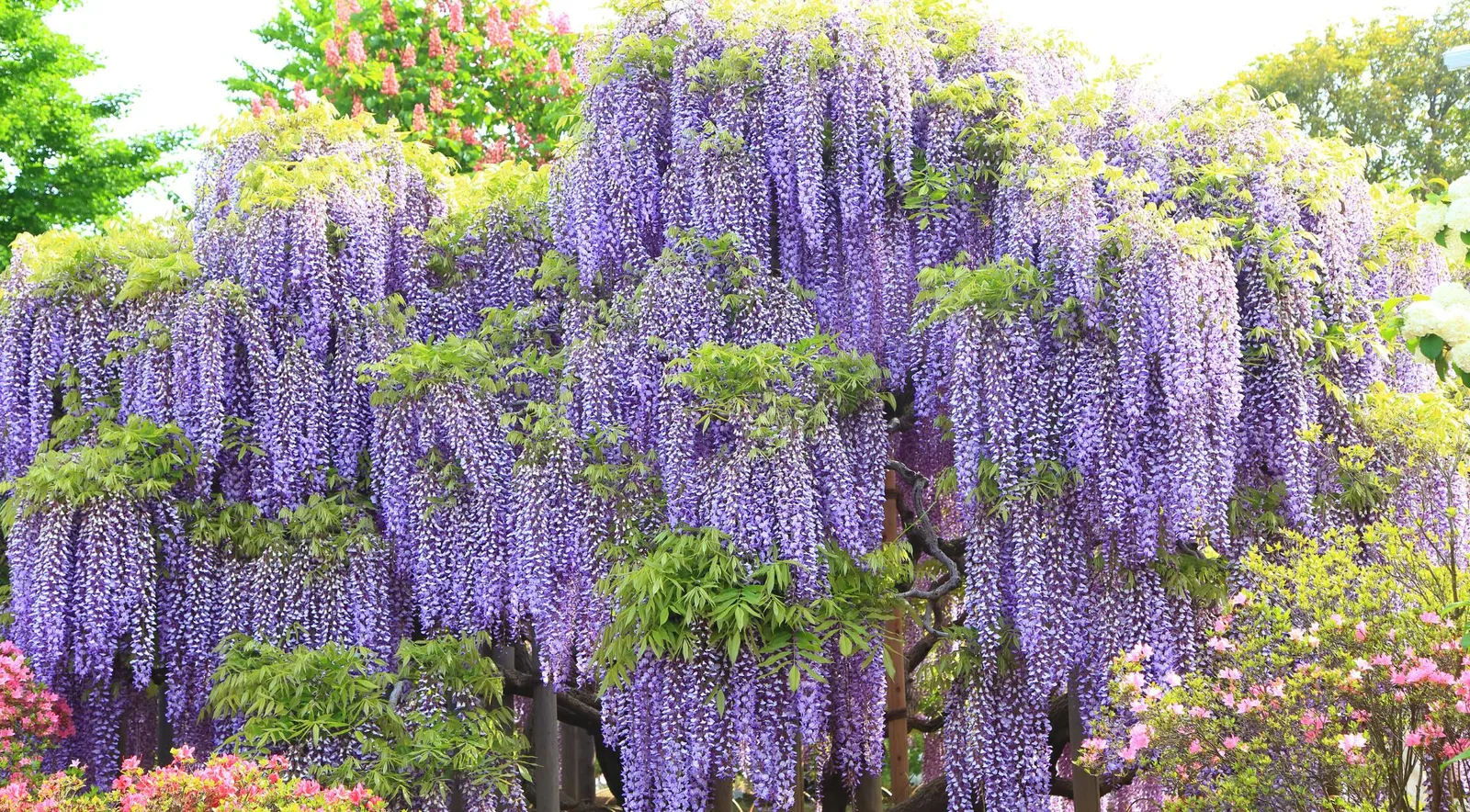
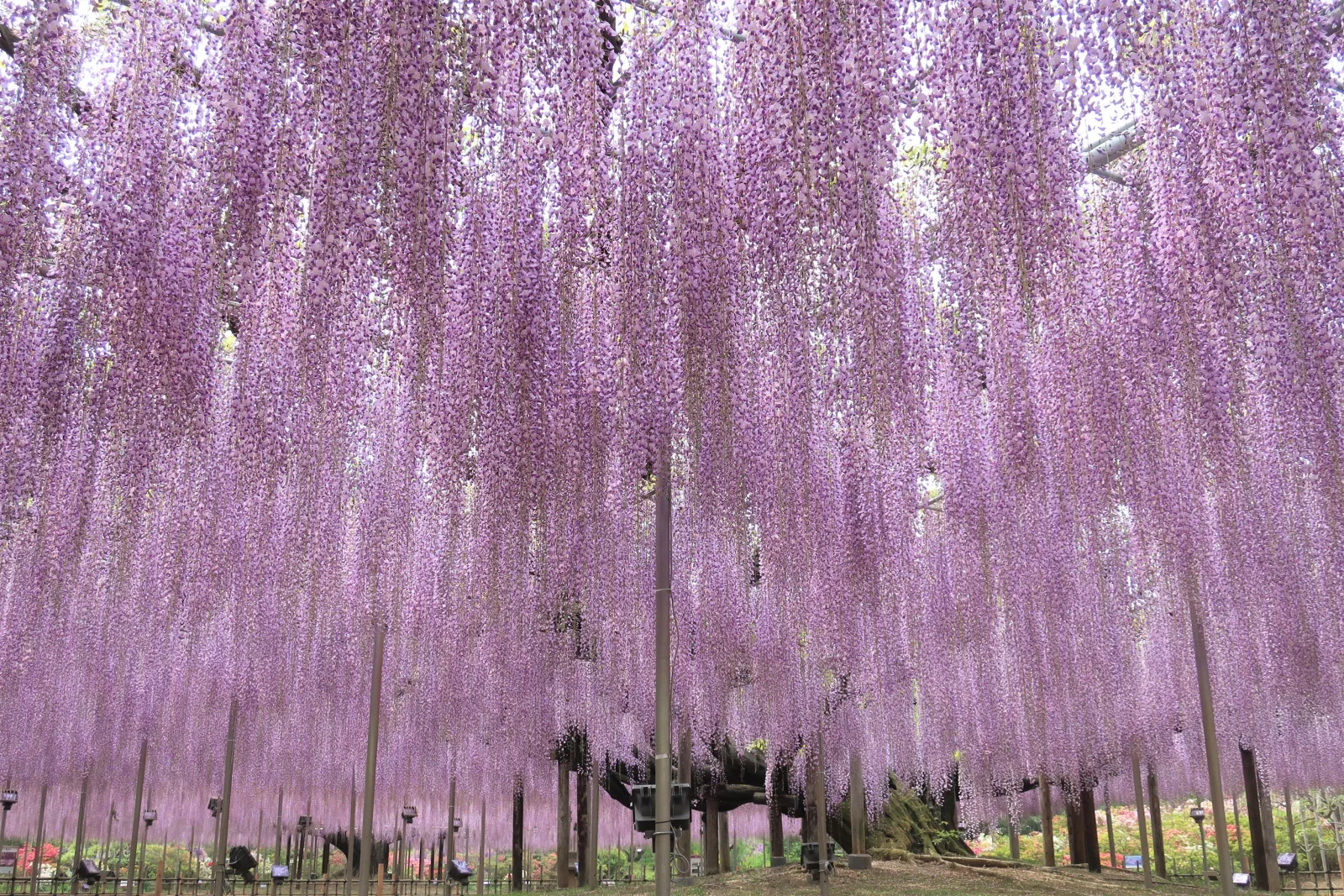
The great wisteria is not a single tree. The park describes four: three Noda kushaku-fuji, a long-tressed variety, and one double-flowered Yae Kokuryu. Together they are more than 160 years old. They were moved here in 1997, at about 130 years old, in what the park calls the first transplant of its kind to succeed in Japan, led by Konami Tsukamoto, Japan’s first female tree doctor. The park itself began in 1968 as Hayakawa Nursery and reopened on this site in 1997, when the trees arrived.
The trellis covered 72 square metres when the trees were planted here. It now spreads over about 1,000 square metres, the size of 600 tatami mats. You walk under it, with the flowers hanging just above your head, a different view from a garden where the blooms grow at ground level.
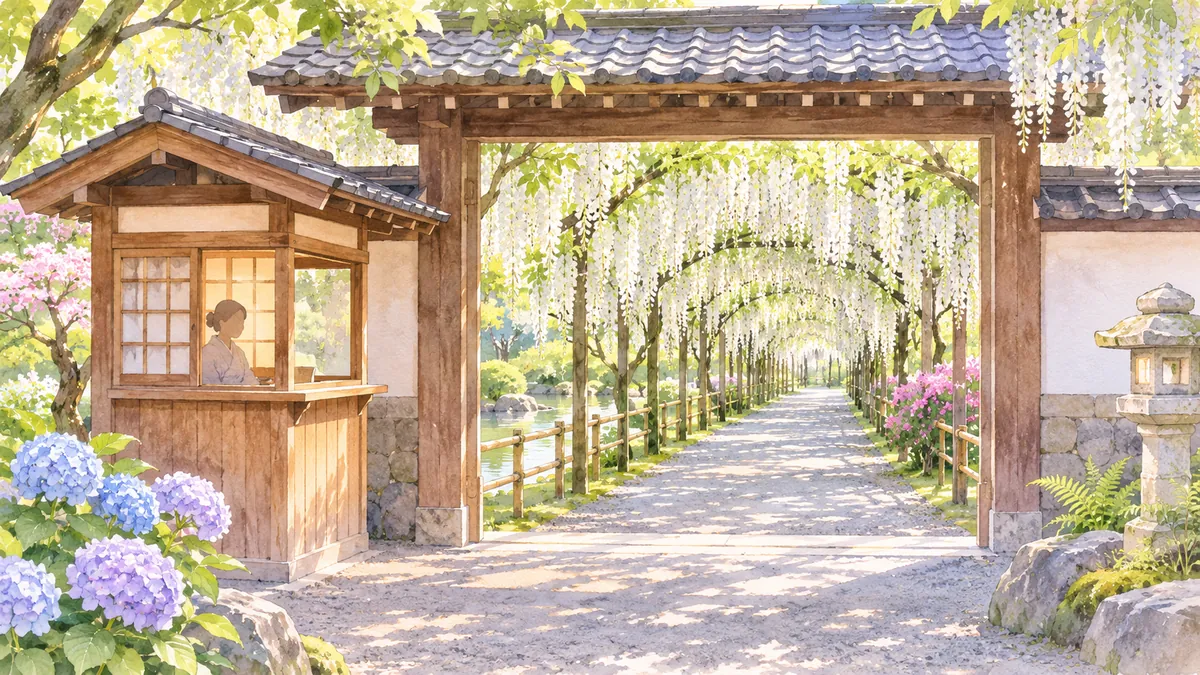
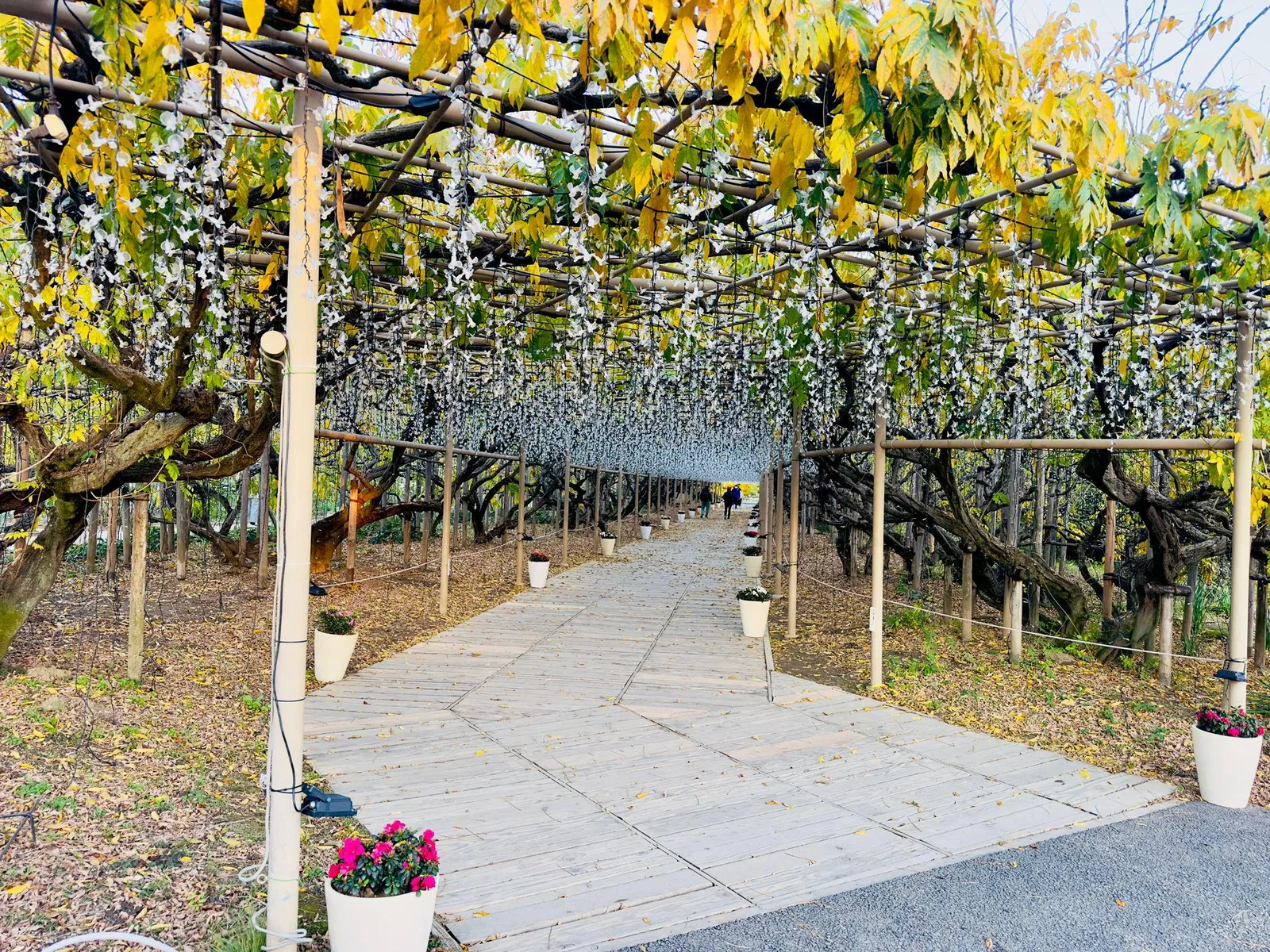
The 80-metre white wisteria tunnel flowers a little later, in early May. It and the great wisteria are both Tochigi Prefecture natural monuments. Around them the park has more than 350 wisteria trees and more than 5,000 azaleas, so even a week either side of the great wisteria’s peak there is colour.
The yellow “wisteria” is laburnum (kingusari in Japanese), a lookalike that flowers last. If someone tells you about the other famous wisteria tunnel, Kawachi Fujien, it is in Kitakyushu, far to the south-west, and cannot be added to this trip.
Other experiences
Other Ashikaga Flower Park tours from Tokyo
More ways to explore the area. Each listing shows its own cancellation policy.
Festival Dates, Hours and Admission
The wisteria festival ran from 11 April to 20 May 2026, its 29th year. The 2027 dates have not been announced; past festivals suggest mid-April to around 20 May. Hours change through the festival. In 2026 the park opened at 9:00 at the start, at 7:00 with the lights on until 21:00 from 18 April to 6 May, and closed at 20:30 for most of May. Expect a similar pattern in 2027, and check the park’s own website (ashikaga.co.jp) for your date.
The day ticket in the 2026 festival cost ¥1,200–2,300 for adults and ¥600–1,200 for children. The price is set on the day by how well the flowers are blooming, which makes it a free bloom meter: a price at the top of the band means the great wisteria is in full bloom, and a price near the bottom means it is just opening or fading. Check the park’s latest flower report and that day’s price before you set off. The tickets guide has every seasonal band.
Day or Night: The Wisteria Light-Up
In wisteria season a day ticket lets you stay into the evening light-up. In 2026 the lights came on from 15 April, three days earlier than planned. After dark the trellises are lit and the great wisteria is reflected in the pond, and many visitors remember this view most. An evening ticket was sold from 17:30 in 2026, at ¥1,000–1,200 for adults.
So should you go during the day or at night? The best plan in spring covers both: arrive in the mid-afternoon, see the colours in daylight, and stay through dusk for the lights on one ticket. Daytime coach tours leave before the light-up. The Viator Adachi Night Wisteria & Ibaraki Pink Flowers Day Tour is the shared coach that reaches Ashikaga in the evening, from 18 April to 20 May 2027 (“Adachi” appears to be a misreading of the kanji for Ashikaga). By train you choose your own time; check the Tokyo to Ashikaga Flower Park guide for getting back.
Golden Week Crowds and the Smartest Dates
Golden Week falls on peak bloom, so the biggest crowds and the fullest flowers arrive together. In 2027 the holidays are Thursday 29 April and Saturday 1 May to Wednesday 5 May. Japanese media reported 50,000–70,000 visitors on some days in this period, and in 2026 the expressway authority forecast a 40-kilometre jam on the Tohoku Expressway on the morning of 2 May.
Friday 30 April 2027 is an ordinary working day between the holidays, with the great wisteria usually at or near peak. If your dates are flexible, it is a strong choice, though the bloom still varies by year. Weekdays in the last ten days of April are the next best. For any Golden Week date, arrive at opening or stay late, and buy your return train ticket in advance.
Visiting After Mid-May: What Is Past Peak
The most common complaint in lower-rated tour reviews is wisteria that had already gone past its peak. Those reviews mostly come from visits in early to mid May; one, from 12 May 2026, said the wisteria was almost all gone. Spring coach tours keep selling departures into late May, when the white tunnel and the yellow laburnum may still be out but the great wisteria has usually finished.
For the great wisteria, go before about 10 May. If you can only travel later, the best time to visit guide shows what else is in flower; roses usually follow from mid-May. Photographers should plan on the train or a private car with an early start: on peak days in 2026 the gates opened at 7:00, hours before the shared coaches arrive.
Questions About the Ashikaga Wisteria Season
When does the wisteria bloom at Ashikaga Flower Park?
From about mid-April to mid-May, one colour after another. The great wisteria usually peaks from late April to early May, the white tunnel in early May and the yellow laburnum last, in early to mid May.
What are the 2027 wisteria festival dates?
They have not been announced yet. The 2026 festival ran from 11 April to 20 May, and past years suggest mid-April to around 20 May. Check the park’s own website (ashikaga.co.jp) in early spring.
Is the park better during the day or at night in wisteria season?
Both are worth seeing. In spring a day ticket lets you stay on for the evening light-up without paying again. Arrive in the afternoon, see the colours in daylight, and stay for the light-up, when the lit wisteria is reflected in the pond.
How much is admission in wisteria season?
In the 2026 festival a day ticket cost ¥1,200–2,300 for adults and ¥600–1,200 for children, set on the day by the bloom. A higher price means fuller flowers.
Is Ashikaga Flower Park crowded in Golden Week?
On most Golden Week days, yes. Golden Week (29 April and 1–5 May in 2027) lands on peak bloom, and media reported 50,000–70,000 visitors on some days. Go on a weekday such as Friday 30 April 2027, and arrive at opening.
Is the great wisteria one tree?
No. It is a group of four trees, three Noda kushaku-fuji and one double-flowered Yae Kokuryu, more than 160 years old, under a trellis of about 1,000 square metres.
Is the yellow wisteria real wisteria?
No. The yellow tunnel is laburnum, a lookalike that flowers last, usually in early to mid May.
Check Spring Dates for the Blue Flower Hill & Ashikaga Coach
A shared coach from Shinjuku to Hitachi Seaside Park's nemophila and Ashikaga Flower Park's wisteria, with both park admissions included. Spring departures run from 25 April 2027; pick a date in the GetYourGuide calendar.
Check dates and prices